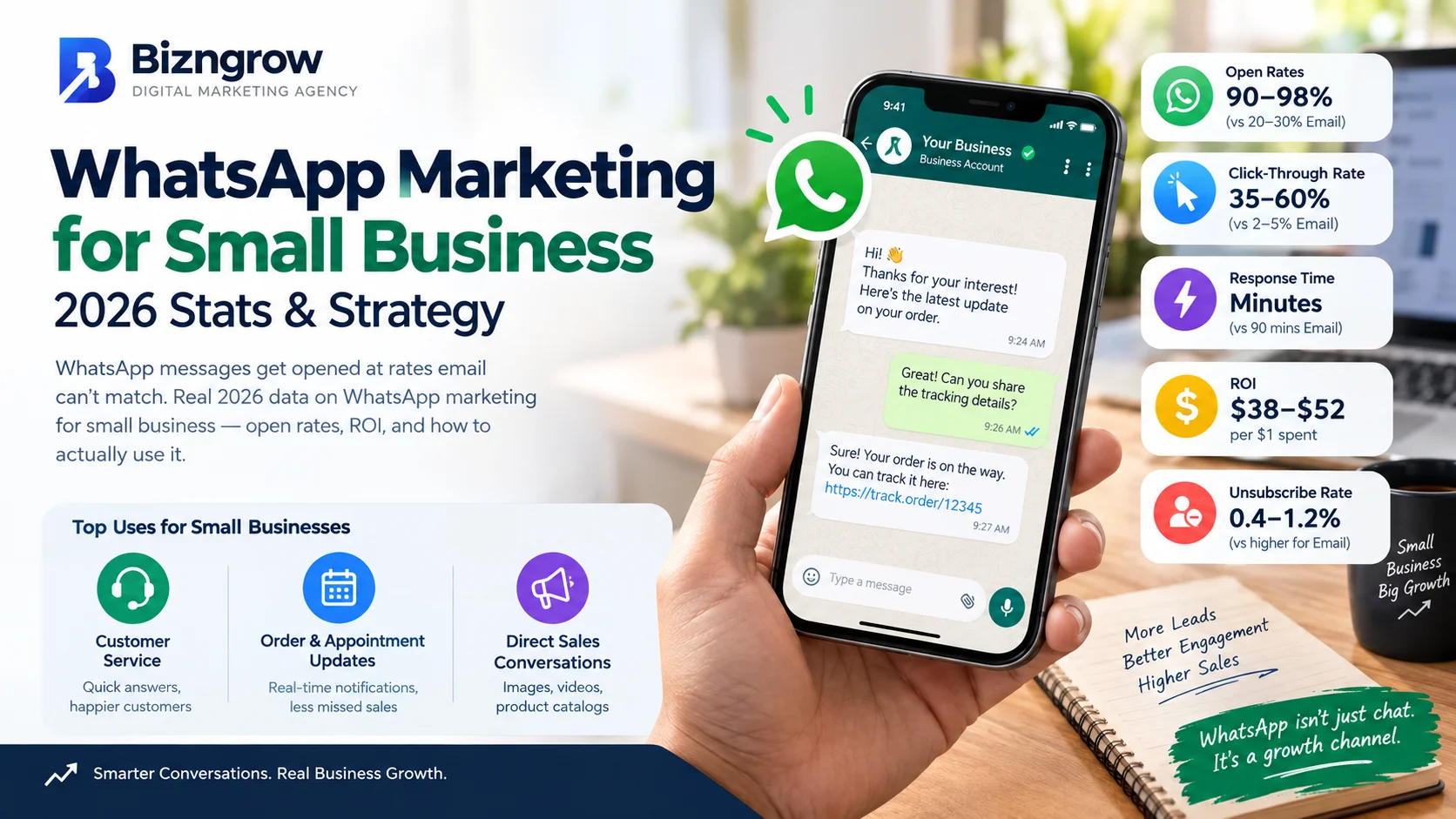
Email open rates have hovered around 20–30% for years. WhatsApp messages, by comparison, get opened at rates between 90% and 98% when the recipient has actually opted in. That gap alone explains why WhatsApp has quietly become one of the fastest-growing marketing channels for small businesses worldwide — not because it’s trendy, but because the math is hard to ignore.
This post covers what the current data actually shows, where WhatsApp fits for a small business, and how to start without overbuilding it.
How Big WhatsApp Business Has Actually Gotten
WhatsApp Business adoption has grown sharply: active WhatsApp Business accounts reached roughly 200–284 million in 2026, up around 40% year over year, and more than 50 million businesses worldwide now use WhatsApp Business every month. The free WhatsApp Business app alone has been downloaded over a billion times on Google Play, reflecting just how far adoption has spread among small and micro businesses specifically, not just large brands with API budgets.
Small businesses aren’t a minor part of this growth — they’re driving it. Small business adoption of the WhatsApp Business API has been growing faster in percentage terms than any other company size segment, aided by platforms that now let a small business set up WhatsApp Business messaging without custom development or a large upfront investment.
Why WhatsApp Outperforms Other Channels on Engagement
The open rate gap is the headline stat, but it’s not the only one worth knowing:
- Click-through rates on WhatsApp Marketing for Small Business campaigns typically run 35–60%, compared to roughly 2–5% for email — often ten times higher
- Response times tend to be dramatically faster than email, where a 90-minute reply is still considered a strong industry benchmark
- Unsubscribe rates on WhatsApp campaigns sit around 0.4–1.2% per campaign, low enough that list fatigue is less of a concern than it is on email, provided messaging stays relevant and opt-in is respected
- Revenue impact for e-commerce specifically has been benchmarked at $38–$52 returned per $1 spent on automated WhatsApp marketing flows — in the same range as email’s strongest benchmarks, and in some studies ahead of it
None of this works, importantly, without genuine opt-in. Every one of these figures assumes the recipient actively agreed to receive messages — WhatsApp marketing sent without consent doesn’t just underperform, it risks the account being restricted entirely.
What Small Businesses Are Actually Using WhatsApp For
The data suggests three clear use cases driving most of the adoption:
Customer service and quick answers. A majority of small businesses report that WhatsApp has made customer communication noticeably more efficient, largely because it removes the back-and-forth friction of email threads or phone tag.
Order and appointment updates. Over half of users say they prefer receiving order confirmations and updates via WhatsApp rather than email or SMS — it’s where people already expect quick, practical notifications to land.
Direct sales conversations. A large share of WhatsApp Business API users now send marketing messages in multimedia formats — images, short videos, product catalogs — turning the channel into something closer to a direct sales conversation than a traditional broadcast.
Where WhatsApp Fits Into a Small Business Marketing Strategy
WhatsApp isn’t a replacement for your other channels — it’s a high-engagement layer on top of them. A booking confirmation from your website development and automated system, an Instagram DM that moves into a WhatsApp conversation for order details (something that connects directly with the strategies on our Instagram marketing page), or a quick response to a Google review that routes a customer toward a WhatsApp chat — these are the moments where WhatsApp earns its open-rate advantage.
This is also where automation does the most work. Manually managing WhatsApp conversations doesn’t scale past a handful of customers a day, which is exactly why automated WhatsApp responses, lead qualification, and follow-up sequences are core to the work covered on our AI marketing agency page — a business can run WhatsApp as a serious channel without someone glued to a phone all day.
For the full data behind the figures in this post, Meta’s official WhatsApp Business page is the primary source on the platform itself, and YCloud’s 2026 WhatsApp statistics roundup compiles a broader set of current benchmarks.
The Honest Limitations
WhatsApp Marketing for Small Business isn’t a universal fit, and the data doesn’t suggest otherwise:
- Adoption and expectations vary sharply by region. Markets like India and Brazil show WhatsApp penetration rates above 90% for business communication, while some Western markets lean more on email or SMS as the default — know your audience before assuming WhatsApp is where they want to hear from you
- Marketing template approval and compliance add overhead that a small business needs to plan for, particularly on the official Business API tier rather than the free app
- It performs best for transactional and conversational messaging, not long-form content — it’s not a replacement for email newsletters or blog distribution, just a different, higher-engagement layer
How to Get Started Without Overbuilding It
- Start with the free WhatsApp Business app for order updates and customer service before considering the paid API tier
- Use it for the moments people actually want speed — booking confirmations, order status, quick questions — rather than broadcast marketing first
- Get genuine opt-in, ideally at the point of purchase or enquiry, rather than importing an existing contact list
- Automate the repetitive parts — FAQs, order status, appointment reminders — so the channel scales without full-time monitoring
- Track click-through and response, not just messages sent, since that’s where WhatsApp’s real advantage over email and SMS shows up
If you’re weighing WhatsApp against other channels for your specific business, our digital marketing services page covers how it typically sits alongside email, SEO, and social rather than replacing any of them, and our case studies page shows how this has worked in practice for other businesses.
FAQ
Is WhatsApp marketing worth it for a small, local business?
Usually yes, particularly for service businesses that handle bookings, orders, or frequent customer questions — the response speed and open rate advantage translate directly into fewer missed enquiries.
Do I need the WhatsApp Business API, or is the free app enough?
Most small businesses can start with the free WhatsApp Business app. The API tier becomes worthwhile once message volume or automation needs grow beyond what the free app can handle.
Will WhatsApp marketing annoy my customers the way spam email does?
Less often, provided messaging stays opt-in and relevant — unsubscribe rates on WhatsApp are notably lower than email, though that advantage disappears quickly if consent isn’t respected.
How does WhatsApp compare to email for ROI?
Current benchmarks put WhatsApp’s revenue-per-dollar in a similar or slightly higher range than email for e-commerce specifically, with the added benefit of faster response and higher open rates — though email still has broader reach for content and newsletters.
Want WhatsApp set up and automated properly for your business? Get in touch and we’ll walk through what’s realistic for your volume and budget. You can also learn more about the team on our About Us page.