Most small business websites aren’t a traffic problem. They’re a leaky bucket problem. Visitors show up, look around, and leave without buying, booking, or calling — not because the business is bad, but because the site never gave them a clear, easy reason to act. Conversion rate optimization (CRO) is the practice of fixing that leak instead of just pouring more traffic into it.
This post covers where your website should realistically land, what actually moves the needle, and where to start if you’re working with a small budget and no dedicated CRO team.
What “Good” Actually Looks Like in 2026
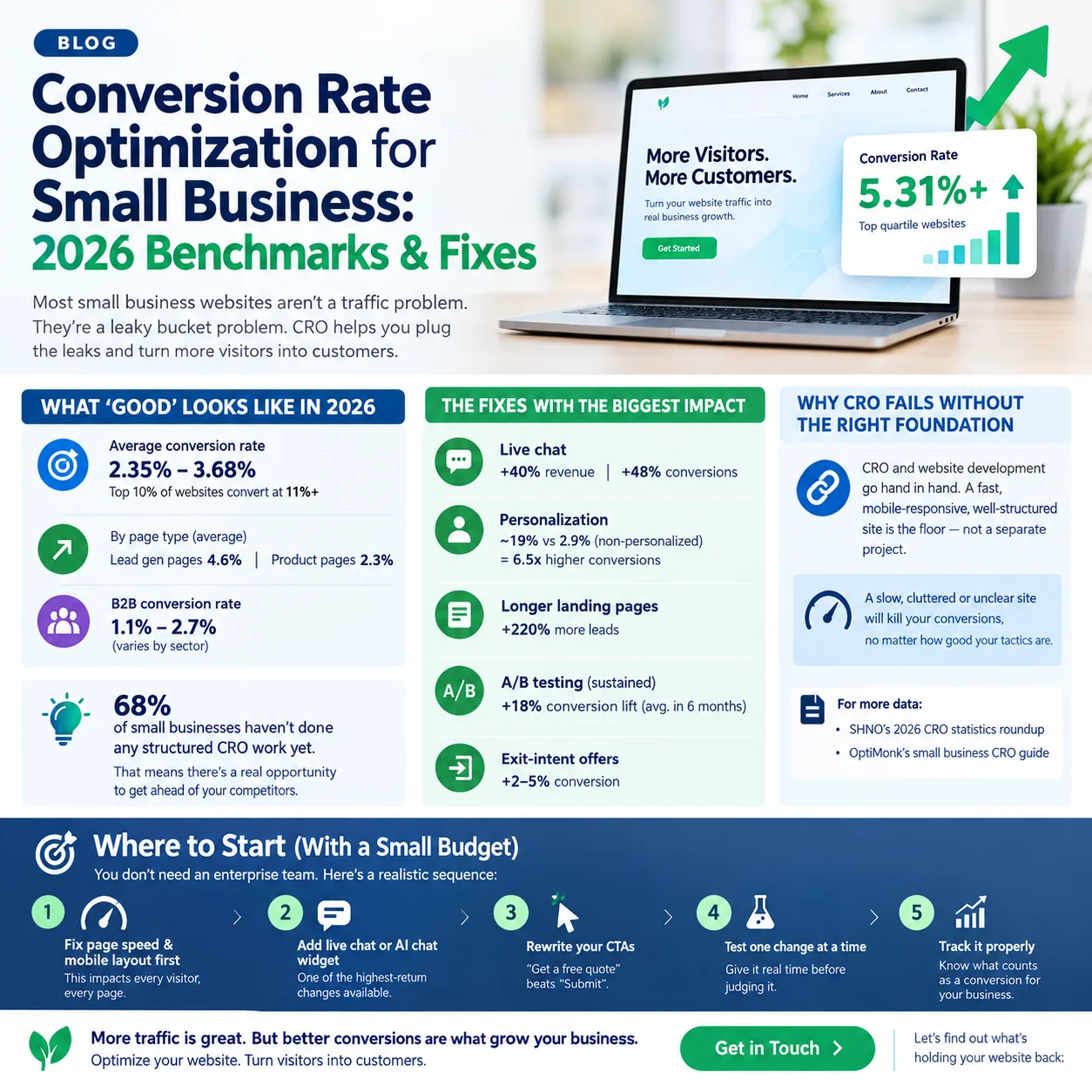
Before fixing anything, it helps to know where you stand. Benchmarks vary by source and methodology, but the pattern is consistent across nearly every study: the average website converts somewhere between 2.35% and 3.68% of visitors, while the top 10% of websites convert at 11% or higher — roughly four to five times the average.
That gap matters more than the average itself. Moving from a 2.35% average conversion rate to the 5.31%+ achieved by the top quartile doesn’t just improve performance modestly — it can double or triple the revenue generated from the exact same traffic, without spending another pound on ads.
Conversion rates also vary meaningfully by page type and industry: lead generation pages convert at around 4.6% on average, product pages closer to 2.3%, and B2B categories range from roughly 1.1% up to 2.7% depending on the sector. If your numbers sit below your category’s benchmark, that’s a signal worth acting on rather than a reason to panic — most small business sites do.
The Uncomfortable Stat: Most Small Businesses Aren’t Even Trying
Roughly 68% of small businesses haven’t done any structured CRO work at all. That’s not a criticism — it’s usually a resourcing problem, not a priorities problem. But it also means CRO is one of the few areas where a small business can get ahead of larger competitors simply by doing something most of them aren’t doing yet.
The return on actually doing it is well documented: structured CRO programs deliver an average ROI of around 223%, and companies running regular A/B testing grow revenue 1.5 to 2 times faster than those that don’t test at all. For context on the acquisition side of that equation, businesses on average spend $92 acquiring traffic for every $1 they spend converting it — a heavily lopsided ratio that CRO exists specifically to correct.
The Fixes With the Biggest Real Impact
Not every CRO tactic is worth the same effort. These are the ones with the clearest evidence behind them:
Live chat. Adding live chat has been linked to a 40% increase in revenue and a 48% lift in conversion rate. For a small business, this is often one of the fastest wins available — it directly answers the hesitation that causes someone to leave without buying.
Personalization. Websites using personalized content — different messaging or offers based on visitor behavior — see average conversion rates around 19%, compared to 2.9% for non-personalized sites, a roughly 6.5x difference. Full personalization tools can be overkill for a small business, but even basic segmentation (returning vs. new visitor messaging, location-based content) captures part of this gain.
Page length on landing pages. Longer, more detailed landing pages generate roughly 220% more leads than short ones — the opposite of what many small business owners assume. People need enough information to feel confident acting, not a bare minimum.
A/B testing, sustained over time. Structured testing produces an average conversion lift of around 18% after six months. The key word is sustained — a single test rarely moves the needle; a consistent testing habit does.
Exit-intent offers. Exit pop-ups timed to when a visitor is about to leave can lift conversion by 2–5%. Modest on its own, but a low-effort addition worth having.
Bounce rate is worth watching alongside all of this — most sites run somewhere between 26% and 70%, and a high bounce rate on your key pages is usually the first sign that something upstream (page speed, unclear messaging, poor mobile layout) needs fixing before any of the tactics above will help.
Why CRO Fails Without the Right Foundation
None of these tactics work well bolted onto a site that’s fundamentally slow, cluttered, or unclear about what it’s asking visitors to do. This is where CRO and core website development overlap directly — a fast, mobile-responsive, clearly structured site is the floor CRO tactics build on, not a separate project to handle later.
For deeper benchmark data behind the numbers in this post, SHNO’s 2026 CRO statistics roundup and OptiMonk’s small business CRO guide are both worth a closer read.
Where to Start With a Small Budget
You don’t need an enterprise CRO team to make progress. A realistic starting sequence:
- Fix page speed and mobile layout first — this affects every visitor, on every page, before any test even runs
- Add live chat or a simple AI-driven chat widget to your highest-traffic pages, since it’s one of the highest-return single changes available — this pairs naturally with the automated lead capture work covered on our AI marketing agency page
- Rewrite your calls to action to be specific (“Get a free quote” beats “Submit”) rather than generic
- Test one change at a time on your highest-traffic page, and give it real time before judging it
- Track it properly — conversion rate is meaningless without knowing what counts as a conversion for your business specifically
If you’re driving traffic from SEO, ads, or Instagram marketing into a site that isn’t converting it, that traffic is being wasted regardless of how good the campaign itself is — which is why we treat conversion and acquisition as one connected strategy rather than separate line items. You can see how this plays out for real businesses on our case studies page.
FAQ
What’s a “good” conversion rate for a small business website?
Anything above the 2.35%–3.68% general average is solid; anything above 5% puts you in the top quartile of websites. The right target still depends on your specific industry and page type.
Do I need expensive tools to start CRO?
No — free tools like Google Analytics (GA4) and basic heatmap tools cover most of what a small business needs to start. The bigger investment is usually time: writing better copy, testing changes, and reviewing results consistently.
How long does it take to see results from CRO?
Some fixes (page speed, a clearer CTA) can show impact within weeks. Structured A/B testing programs typically need several months of consistent testing to show their full lift.
Should I focus on getting more traffic or improving conversion first?
If your current traffic isn’t converting well, more traffic just means more visitors leaking out of the same broken funnel. Fixing conversion first usually delivers a better return before scaling traffic spend further.
Want your website’s conversion rate looked at honestly? Get in touch and we’ll tell you what’s actually holding it back. You can also learn more about the team on our About Us page.