

Content marketing has quietly become one of the best-documented ROI stories in digital marketing — and one of the most commonly under-resourced channels at the small business level. The data below explains why that gap exists, and what to do about it with a realistic budget.
The ROI Case, in Numbers
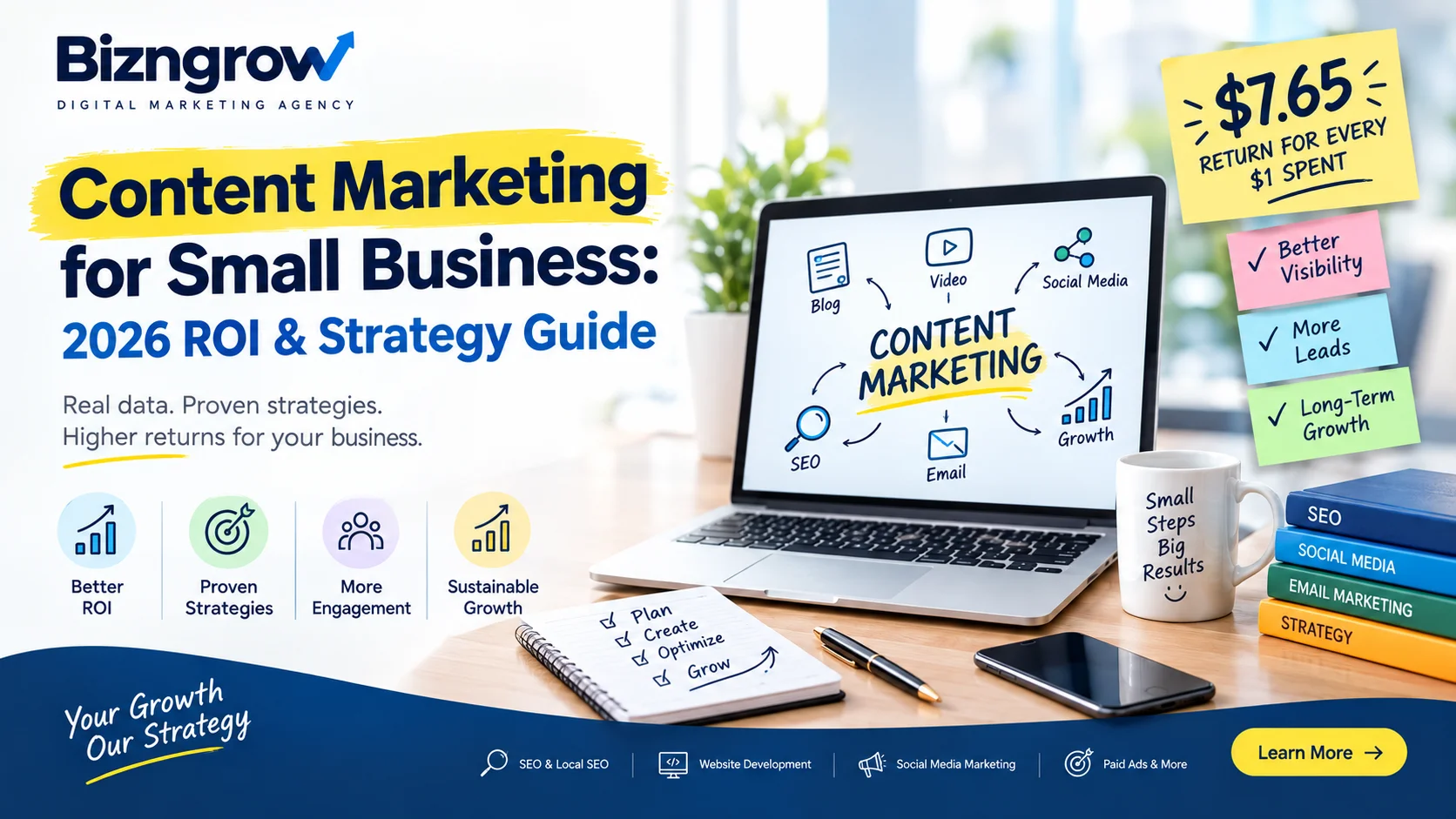
Content marketing now averages $7.65 in return for every $1 spent, well ahead of paid advertising’s roughly $1.80 return on the same basis. Other benchmarks put the gap even wider in specific contexts — SEO-focused content strategies have been shown to deliver returns as high as 748% ROI for B2B companies, compared to roughly 200% for PPC run in isolation. And content marketing consistently outproduces outbound marketing on lead volume too: it generates more than three times as many leads as outbound tactics, while costing around 62% less to run.
None of this means paid ads are a bad investment — they solve a different, faster problem, as covered in our SEO vs PPC comparison. But the ROI math on content is strong enough that most small businesses underinvesting in it are leaving a proven return on the table, not avoiding a risky one.
Small Businesses Actually Outperform the Average Here
This is the detail most small business owners don’t expect: small businesses are 23% more likely than average to see positive ROI specifically from blog posts. That’s a real advantage, not just an encouraging statistic — a small, focused content effort from a business with a clear niche and a direct customer relationship tends to outperform a large, generic corporate content machine on a per-post basis.
Blogging consistency matters more than volume: businesses that blog consistently see roughly 13 times more positive ROI than those that blog sporadically or not at all. Website, blog, and SEO content is now rated the single highest-ROI marketing channel by marketers themselves — ahead of paid social and email — cited by 27% of marketers as their top performer.
What Content Actually Works in 2026
Short-form video leads on engagement, but blogs lead on measurable ROI. Short video is the single highest-ROI content format overall, but blog posts remain consistently among the top five highest-ROI formats, cited by roughly 22% of marketers — a notable result for a format many assume has been eclipsed by video.
Video has become close to universal, with 91% of businesses now using it as a marketing tool, and 93% of those calling it essential rather than optional. Length matters more than most businesses assume: 91% of people say the optimal video length is under two minutes, with just over half preferring something closer to 30–60 seconds.
Evergreen content significantly outperforms trend-chasing content, delivering roughly four times the ROI of seasonal or trendy posts over time — a useful corrective for any small business tempted to chase every trending format instead of building a durable base of genuinely useful content.
AI has changed the economics of content production entirely. 94% of marketers plan to use AI in content creation in 2026, and more than half of small businesses using AI tools report no additional content creation costs at all — AI has effectively become the primary cost-reduction mechanism making content marketing viable at small business scale. Businesses that have adopted AI content tools report meaningfully higher ROI as a direct result, with positive-ROI reporting climbing from under half two years ago to around 71% today among adopters.
The Budget Reality for Small Business
Most small businesses are working with far smaller content budgets than enterprise benchmarks suggest: 71% of small businesses not using AI spend $1,000 or less per month on content. That’s not necessarily a problem — it’s simply the honest starting point most small business content strategies need to work within, which is exactly why AI-assisted production and consistency matter more than raw spend for this segment.
Where Content Marketing Fits Into Your Wider Strategy
Content rarely performs in isolation — it works best feeding and feeding from your other channels:
- SEO and blog content are the engine behind organic search visibility long-term, directly connected to the kind of work covered on our digital marketing services page
- Video and short-form content distributed through social builds the audience and trust that email and WhatsApp later convert — see our Instagram marketing page for how that distribution typically works
- AI tools are now central to making consistent content production realistic for a small team, which overlaps directly with the automation work on our AI marketing agency page
- The website your content sends traffic to has to actually convert that interest — tied closely to website development and the conversion fundamentals covered in our CRO guide
For deeper data behind the figures in this post, Review42’s 2026 content marketing statistics and SHNO’s content marketing ROI breakdown are both thorough, regularly updated sources.
A Realistic Content Plan for a Small Business Budget
- Pick one primary format and commit to consistency before spreading across five platforms — the 13x ROI gap tied to consistency matters more than channel breadth
- Build evergreen content first, saving trend-driven content for a smaller supporting share, given its 4x ROI advantage over time
- Use AI to handle first drafts and production speed, not to replace the judgment of knowing your customers and your niche
- Keep video short — 30 to 60 seconds, matching what audiences actually say they prefer
- Track which content actually drives enquiries, not just views — only 36% of marketers say they can accurately measure content ROI, so building that measurement habit early is itself a competitive advantage
You can see how this plays out for real businesses on our case studies page.
FAQ
Is content marketing really worth it for a small business with a tiny budget?
Yes — small businesses specifically show a higher likelihood of ROI from blog content than the average business, and AI tools have significantly lowered the cost of consistent production, making this one of the more accessible high-ROI channels available.
Should a small business prioritize blogging or video first?
Both have strong data behind them. If resources are limited, blogging tends to have the clearer, more measurable long-term SEO compounding effect, while short-form video tends to win on immediate engagement and reach.
How much should a small business budget for content marketing?
Many small businesses operate successfully on $1,000 a month or less, particularly when using AI tools to reduce production costs — the bigger factor is consistency over time, not a large upfront budget.
Does AI-generated content actually perform as well as human-written content?
Businesses using AI content tools report measurably higher ROI on average, though the strongest results tend to come from AI-assisted content that’s still reviewed and refined by a person familiar with the business, not fully automated output.
Want a content plan built around your actual budget and niche? Get in touch and we’ll map out something realistic. You can also learn more about the team on our About Us page.